AI Marketing Agents: What They Are and How to Start
10 min read
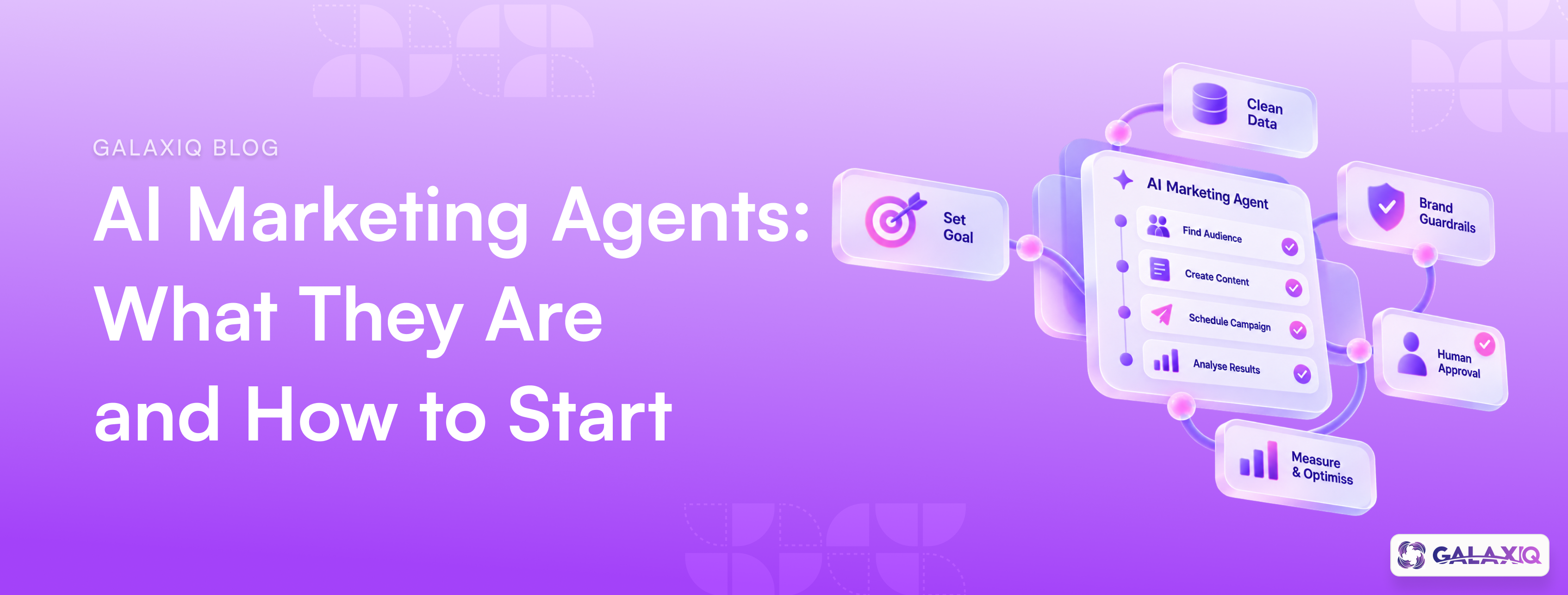
An AI marketing agent is AI software that works towards a marketing goal by planning and completing several steps on its own, such as building an audience, drafting the messages and scheduling the send, instead of just answering one prompt. The best results in 2026 come from giving agents one well-defined job, clean data, clear brand rules and a human who approves anything that matters.
This guide explains what AI marketing agents are, how they differ from the AI assistants you already use, what they're good at, why so many agent projects stall, and how to launch your first one.
Key takeaways
- An AI assistant drafts when you ask. An AI agent works towards a goal and takes several steps on its own.
- Adoption is rising fast, but results are uneven: 45% of martech leaders using agents say vendor agents haven't met expectations.
- Agents fail mostly on data, unclear goals and missing guardrails, not on the AI itself.
- Start with one repeatable workflow, set guardrails, keep a human in the loop, and measure against a baseline.
What is an AI marketing agent?
Most marketers already use AI assistants: you type a prompt, you get a draft, you edit it. An AI marketing agent goes further. You give it a goal, and it works out the steps, uses the tools and data it has access to, and completes the work, checking in with a person where you've told it to.
A simple way to see the difference:
- AI assistant: "Write me a welcome email."
- AI agent: "Run a welcome journey for new customers this month." The agent finds the right customers, drafts the emails in your brand voice, sets the timing and reports what happened.
Gartner warns about "agentwashing": vendors calling AI assistants "agents" when they still depend on human input for every step. If a tool only responds when you prompt it, it's an assistant, whatever the label says. That's worth checking when you compare vendors.
How widely are marketers using AI agents in 2026?
The numbers depend on how each survey defines "agent", which is worth knowing before you compare them:
- Gartner (2025): 81% of martech leaders are either piloting AI agents or have already implemented them (survey of 413 martech leaders).
- Salesforce (2026): only 13% of marketers say they currently use agentic AI, though high performers are nearly twice as likely as underperformers to use AI agents (survey of 4,450 marketers).
- HubSpot (2026): 86% of marketers use agents, in a survey that counts everyday tools like ChatGPT as agents.
The honest summary: most marketing teams are experimenting, and far fewer have agents doing real, multi-step work in production.
Gartner expects that to change. It predicts that by 2028, 60% of brands will use agentic AI to deliver streamlined one-to-one interactions with customers.
What can AI marketing agents actually do?
According to Gartner, the top use cases for marketing AI agent pilots are content or marketing asset production (52%), content enrichment (49%) and campaign management or optimisation (43%).
In practice, these are the jobs agents handle well today:
1. Audience and segmentation agents
Watch customer behaviour, spot patterns and build segments, such as customers whose spending is dropping or first-time buyers ready for a second purchase. (Our guide to AI customer segmentation covers 8 segments worth building.)
2. Campaign agents
Turn a goal or idea into a campaign: the message, the posts, the visuals and a schedule across channels.
3. Customer conversation agents
Chatbots and voice agents that answer questions, guide customers and create service tickets, handing over to a person when needed.
4. Analytics agents
Answer questions about your data in plain English, explain what changed and suggest what to do next. (More in conversational analytics for marketing
5. Content operations agents
Resize, adapt, translate and check content against brand rules across channels.
Why do so many AI agent projects fail?
The warning signs are clear in the research:
- Gartner predicts over 40% of agentic AI projects will be cancelled by the end of 2027 because of escalating costs, unclear business value or inadequate risk controls.
- 45% of martech leaders using agents say vendor-offered agents don't meet their expectations of promised business performance, and half say their organisation lacks the technical and data readiness agents need.
Those findings point to five common causes:
- Messy or disconnected data. An agent can only act on what it can see. If customer data is scattered across tools, the agent works from half the picture.
- No clear goal. "Use AI agents" isn't a goal. "Cut the time to launch a campaign from two weeks to three days" is.
- No brand guardrails. An agent producing content at speed without brand rules produces off-brand content at speed. (See how to keep AI content on-brand (/blog/keep-ai-content-on-brand/).)
- No human checkpoints. Fully hands-off from day one is how mistakes reach customers.
- No baseline. If you didn't measure the old way, you can't prove the agent is better.
How to launch your first AI marketing agent in 5 steps
Step 1: Pick one repeatable workflow.
Choose work that happens often, follows a pattern and has a clear outcome. Good first picks: a monthly campaign to one segment, a win-back journey, or weekly performance summaries. Avoid anything high-risk, like pricing or regulated claims, for your first agent.
Step 2: Connect the data it needs, and only that.
List the data the workflow depends on (for example, purchase history and email engagement) and make sure it's accurate and connected. Don't wait to fix all your data. Fix the data this one workflow needs.
Step 3: Write the guardrails.
Give the agent your brand voice, banned phrases, approved facts and the things it must never do on its own. Decide what it can do without approval and what needs a person.
Step 4: Keep a human in the loop at first.
For the first month, a person reviews everything before it reaches customers. Track what they change. As accuracy improves, move low-risk steps to "approve by exception".
Step 5: Measure against your baseline.
Compare time saved, output quality and results (such as conversion or response rate) with how the same workflow performed before. Keep the agent only if it's actually better.
How GalaxiQ approaches AI agents
In GalaxiQ, agents work inside one connected enterprise AI marketing platform (/) rather than as separate tools, so they share the same brand rules and customer data:
- Atlas, the AI segmentation agent in EdgeIQ, analyses customer behaviour to build and refine segments, and designs journeys from a plain-English description.
- Ideanise turns one idea into a full campaign with on-brand posts, visuals and a schedule, which you can edit or drop before anything goes live.
- Aivora runs chat and voice agents trained on your business knowledge, with human takeover built in.
- BrandForge supplies the brand voice every agent uses, and InsightIQ reports on what they did.
Frequently asked questions
An AI marketing agent is AI software that works towards a marketing goal by planning and completing several steps itself, such as building an audience, creating content and scheduling it, rather than responding to a single prompt.