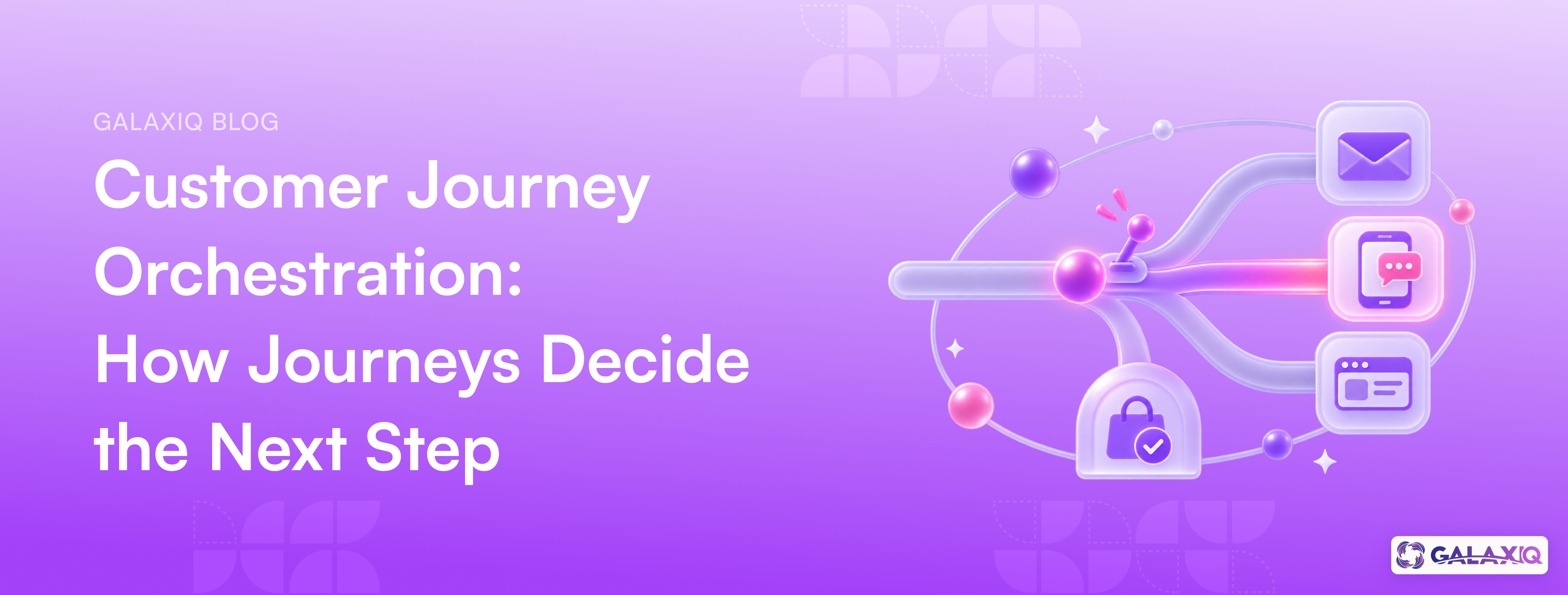
Customer Journey Orchestration: How Journeys Decide the Next Step
10 min read
On 3 September 2026, Adobe announced that its next chief executive, from 1 December, will be Anil Chakravarthy, the president of its Customer Experience Orchestration business. When a software company of that size picks its next CEO from the team that coordinates customer journeys, it tells you where enterprise marketing is heading. The idea itself isn't new. What has changed is that customer data now arrives in real time, so a journey can react to a purchase, a browse or a support chat within minutes. That only helps if the journey is built to listen.
Key takeaways
- Orchestration chooses each customer's next step from their latest behaviour. Automation follows a fixed sequence.
- Every journey is built from seven parts: entry, waits, branches, channel choice, exits and goals, re-entry, and frequency rules.
- Most journey mistakes happen at the exit. A customer who has bought should stop getting "come back" messages straight away.
- Channels need shared rules, or email and SMS end up messaging the same person in the same hour.
- In Australia, an unsubscribe has to be honoured within five working days, across every journey that could message that person.
What is customer journey orchestration?
Customer journey orchestration is the coordination of every message and experience a customer receives, across channels, based on what they do. Each step is decided per person, at the moment it is needed.
| Marketing Automation | Journey orchestration | |
| What triggers the next step | A timer: day 1, day 3, day 7 | The customer's latest action, or a wait that ends early when they act |
| Channel | Usually one, often email | Chosen per step: email, SMS, push, onsite, in-app |
| When the customer does something unexpected | The sequence carries on | The journey branches or ends |
| When it stops | At the last message | When the goal is met or the customer no longer fits |
It also isn't the same as journey mapping. A journey map is a diagram of how customers move through your business. Orchestration is the system that acts on that map, one customer at a time.
The seven building blocks of an orchestrated journey
Adobe's guide to journey entry and exit criteria for Journey Optimizer is a good reference, because it names most of the parts every platform uses.
- Entry. What lets someone in. Adobe lists event-based, audience-based and attribute- based entry: a customer abandons a cart, joins a segment, or reaches a loyalty tier.
- Waits. Pauses between steps. A good wait ends early if the customer acts, rather than holding them for a fixed time regardless.
- Branches. Decision points based on what the customer did, or on a score. Salesforce, for example, lets teams use Einstein engagement scores to split paths in Journey Builder.
- Channel choice. Which channel carries each step: email for detail, SMS for urgency, onsite for people already browsing.
- Exits and goals. When someone leaves. Adobe's guide lists four routes: finishing the journey, reaching a success metric such as a purchase, an inactivity timeout, or no longer qualifying for the audience.
- Re-entry. Whether the same person can go through the journey again, and how long they must wait before they can.
- Frequency and conflict rules. Limits on how many messages one person gets, and which journey wins when two want the same customer.
Where journeys quietly go wrong
Platforms document these limits. Teams often find them in production.
Exits that wait for a timer. In Braze, when a customer performs a Canvas exit event, they are marked to exit immediately and don't advance to later steps. But if they are in a Delay step, they stay there until the delay ends. Braze's own example: a customer in a 30-day
delay who exits on day one doesn't fully leave the Canvas until 29 days later. They won't get further messages, but your reporting will show them as still in the journey.
Exits built on slow data. Adobe's documentation says that from September 2026, Journey Optimizer blocks publication of any new, draft or duplicated journey that uses a batch audience in its exit criteria. The reason is simple. If "has purchased" is only updated overnight, the customer gets a reminder for something they already bought. Our guide to real-time CDPs explains why data speed decides this
Channels that don't talk to each other. An email journey and an SMS journey can both be correct and still message the same person twice in an hour. Adobe's guide connects exit criteria directly to frequency capping and avoiding over-communication. Klaviyo's own
browse abandonment setup adds a filter so customers don't get emails from the browse and cart flows at the same time. Rules like these only work if every channel and journey shares them.
Journeys nobody looks at again. A journey built for last year's offer keeps running. Give every journey an owner and a review date.
A worked example: one browse, five decisions
Here's what an orchestrated browse-to-purchase journey looks like in plain English:
- Entry: a known customer views the same product twice in 24 hours.
- Wait: one hour, ending early if they add it to the cart. Klaviyo recommends a delay of at least an hour before a browse abandonment message.
- Branch: if they added to cart, hand them to the cart journey and exit this one. If not, send an email with the product and its reviews.
- Channel switch: if they click but don't buy within two days, show an onsite message on their next visit instead of sending another email.
- Exit: the moment they buy that product. Braze shows how to match the exit to the entry, so buying a different item doesn't end a reminder about the one they left.
Across all of it, a frequency rule caps marketing messages at one a day, whichever channel sends them.
For how six platforms handle the first step, see our browse abandonment test.
A note for Australian teams
Under the Spam Act, the ACMA says every commercial electronic message needs consent and accurate sender identification. It also needs an unsubscribe option that is honoured within five working days and keeps working for at least 30 days after the message is sent.
For orchestration, that means an unsubscribe can't stay inside one journey. When someone opts out of a channel, every journey that could message them on that channel needs to know, and five working days is the legal maximum, not the target. This isn't legal advice: check your consent records with your compliance team.
Five questions to test journey orchestration
Ask these in a demo.
- "Show me a customer leaving the journey the moment they buy." Including when they are in a wait step. How long until they stop receiving messages, and until reporting shows they've left?
- "Can exits use real-time events?" If exit rules run on overnight data, expect reminders after purchase.
- "How do you stop two journeys messaging the same person?" Ask about frequency caps and priorities across all channels, not per journey.
- "What happens when someone unsubscribes in one channel?" Watch the suppression reach every live journey.
- "Can I see why a customer took a branch, and hold out a control group?" Without a holdout, you can't tell whether the journey caused the sale.
How GalaxiQ handles journey orchestration
GalaxiQ's journey orchestration runs in EdgeIQ, the customer data platform at the centre of GalaxiQ's enterprise AI marketing platform. Journeys are built where the customer data already lives, so there is no export between the segment and the send. Here's how it works:
- Journeys from a prompt: describe the goal in plain English. Atlas, EdgeIQ's AI agent, designs the journey, the audience and the trigger logic, and picks the channel for each step.
- Live segments as the entry: journeys start from segments that Atlas keeps up to date, while the Architect Agent keeps mapping each customer to the segments that fit them.
- Ranked next-best actions: for every segment, EdgeIQ suggests actions such as a personalised email, onsite popup, SMS nudge or video, matched to intent.
- One canvas for every channel: the live journey view coordinates email, popup, SMS and video, with live status, traffic allocation and one-click activation.
- Content that tests itself: generate several content variants per action, and Atlas balances traffic towards the best performers. The content comes from Ideanise in your brand voice.
Now the cautious part. GalaxiQ was founded in Sydney in 2025, so it has a shorter track record than Adobe, Salesforce or Braze. Email and SMS steps still need a known customer who has agreed to hear from you. And exit and frequency rules are where every platform
should be tested, ours included. Ask us to run the five questions above on one of your own journeys.
How the platforms compare
Based on each vendor's own documentation, checked 18 November 2026.
| Platform | How journeys are built | How customers exit | Worth knowing |
| Adobe Journey Optimizer | Visual canvas with event, audience or attribute entry | Completion, success metric, inactivity timeout or audience disqualification | From September 2026, new journeys can't use batch audiences in exit criteria |
| Braze Canvas | Visual canvas with entry rules and steps | Exception events mark the user to exit immediately | Users in a Delay step stay there until it ends, then leave |
| Klaviyo flows | Flow builder triggered by a metric, such as Viewed Product | Profile filters drop anyone who has, for example, placed an order or started checkout since entering the flow | Its browse abandonment setup adds a filter so customers don't get emails from the browse and cart flows at once |
| GalaxiQ (EdgeIQ) | Plain-English prompt; Atlas designs the logic, triggers and channels | Test exits and frequency rules on your own \journey in a demo | Newer platform; content and segments live in the same workspace |
Frequently asked questions
It is the coordination of every message and experience a customer receives, across channels, with each next step decided from what that customer just did.