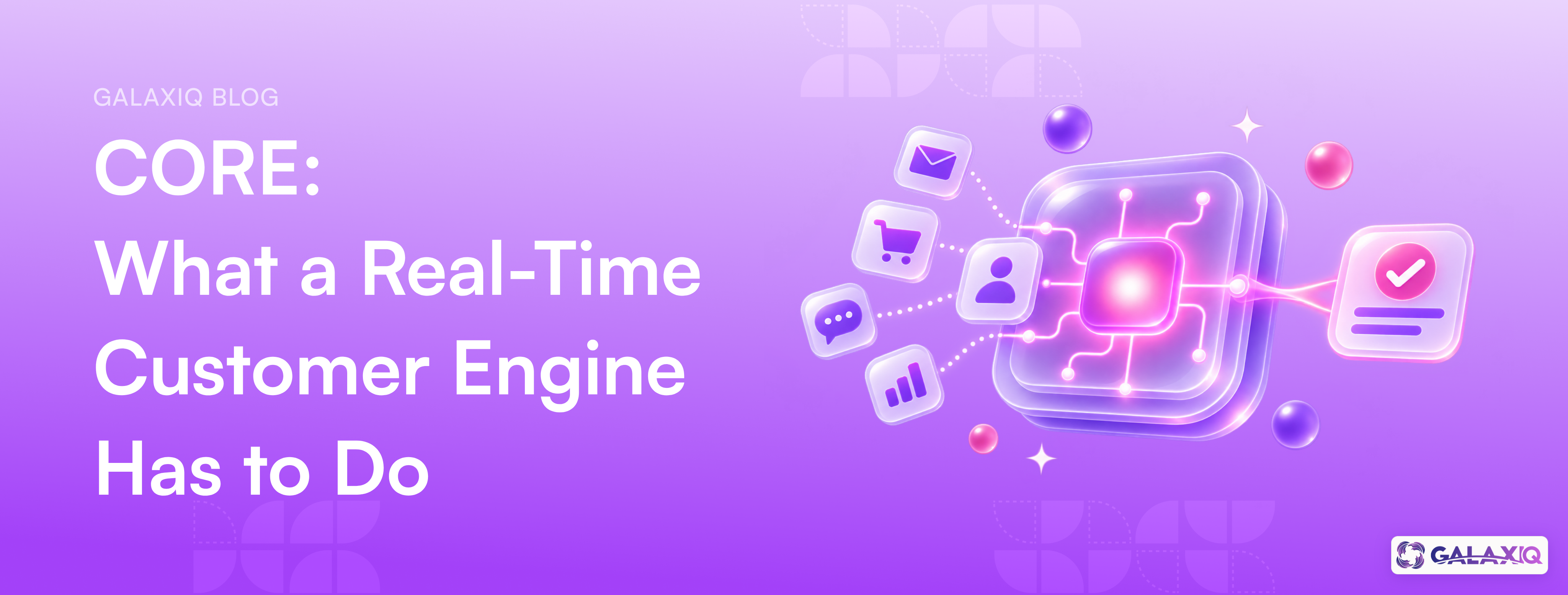
CORE: What a Real-Time Customer Engine Has to Do
10 min read
The scatter is measurable. Salesforce's 2026 Connectivity Benchmark Report, a survey of 1,050 enterprise IT leaders run with Vanson Bourne, found that the average enterprise now uses 957 applications, up from 897 a year earlier, and only 27% of them are integrated. In the same survey, 86% of IT leaders said they are concerned that AI agents will add more complexity than value without proper integration.
So the question for marketers isn't whether you have customer data. You have plenty. It's whether any single system can see all of it at once, and act on it before the moment passes.
That's the idea behind CORE. Bring your scattered data to its core.
Key takeaways
- A real-time customer engine does four jobs: keep one live customer record, decide the next step, act while the customer is present, and learn from what happened.
- Real-time decisioning picks one action from many by filtering what's allowed, then ranking what's left by likelihood, context and value.
- The engine is only as good as the data it can see. With 27% of enterprise apps integrated, most decisions are made on partial records.
- AI ranking needs traffic. Adobe recommends 1,000 impressions and 100 conversions per offer per week for its models to work well.
- If a platform can't explain why a customer saw an offer, you can't fix it when it's wrong.
What CORE means
ORBIT describes the four jobs a unified marketing platform does around one centre: orchestration, reach, brand intelligence and targeting. CORE is that centre. It is the engine everything else circles.
| Letter | Stands for | The job |
| C | Customer | Keep one live record per person, joined across devices and tools |
| O | Orchestration | Decide the next step: which message, offer or journey, on which channel |
| R | Real-time | Act while the customer is still there, not in tomorrow's batch |
| E | Engine | Learn from every outcome, so the next decision is better than the last |
CORE also ties together two jobs we have written about separately. A real-time CDP supplies the live customer record, and customer journey orchestration carries out the steps. The engine is what decides between them.
The acronym matters less than the order. Each job depends on the one before it. An engine that decides brilliantly on a stale or half-joined record still makes the wrong call, just faster.
How a real-time engine picks the next action
Real-time decisioning is the process of choosing the single best action for one customer at one moment, out of everything you could do. Pega documents the process in its Customer Decision Hub training. It works as a funnel:
- Filter what's allowed. In Pega's example, a bank has 200 possible actions. The engine first checks eligibility conditions, then applicability, then suitability, to leave only the actions this customer can and should receive.
- Rank what's left. Pega's arbitration weighs four numbers: propensity (how likely the customer is to respond, calculated by AI), context weighting (what is happening right now), business value (what the action is worth) and business levers (manual priorities the business sets).
- Apply the limits. Frequency caps stop the same offer appearing again and again. In Adobe Journey Optimizer, an offer is capped as soon as any one of its capping rules reaches its threshold.
- Act on the channel in use. How many actions are shown depends on where the customer is. Pega's example is a website showing the top three actions, plus two tiles and one hero banner.
- Learn. Every response, or lack of one, updates the models for next time. Context is what separates a decision from a guess. Pega's own example: if a customer contacts the bank to close their account, the highest-priority action is keeping them. An upsell might have the highest propensity on paper. A good engine still knows it's the wrong moment.
Where real-time decisioning goes wrong
The vendor documentation is honest about the limits, if you read it.
AI ranking needs traffic. Adobe recommends 1,000 impressions and 100 conversion events per offer per week for its AI ranking models to perform well. With large catalogues, some offers get by on 250 impressions and 25 conversions per 30 days, but Adobe says those minimums may not guarantee optimal performance. A small brand with 40 offers and modest traffic should start with rules and simple ranking, not a model.
Decisions you can't explain. Adobe now offers a Decisioning Explainer that answers in plain language why a specific offer was or wasn't shown to a profile. It traces which offers were eligible, which rule excluded each one, whether capping suppressed it, and which ranking score won. That a market leader built this tells you how often teams are left asking "why did she get that?"
Levers that drown out relevance. Business levers let the business nudge the engine towards a product it wants to push. Pega's example is a mortgage team favouring its mortgage offer even when it ranks a little lower than a credit card. Used lightly, that's sensible. Used heavily, every customer gets the quarter's priority product and the propensity model stops mattering.
Decisions on a fragment. This is the scatter problem again. If purchases live in the store platform, support tickets in the helpdesk and email clicks in the email tool, the engine decides on whichever slice it can reach. The customer who complained this morning still gets the upsell.
What a real-time customer engine is for
The payoff is fewer wrong messages, not more messages.
- The right offer, or none. Ranking across every possible action means a customer sees the most relevant one, and sometimes the right answer is to send nothing.
- Service before sales. Context weighting puts a fix ahead of a pitch when a customer is unhappy.
- Less waste. Caps and real-time updates stop discounts going to people who just bought at full price.
- One answer to "why?" When every channel draws on the same engine, there's one place to look when a decision looks wrong
Five questions to test a real-time customer engine
Take these to any demo, including ours.
- "If a customer buys on the website, how long until every channel knows?" Ask them to show it, not tell you.
- "How do you choose between two actions for the same customer?" Ask what the ranking weighs, and who can change the weights.
- "Can you show me why this customer got this offer?" A clear, specific answer is the minimum.
- "What happens when there isn't enough data for the AI?" Ask for the traffic thresholds and what the engine does below them.
- "Which of my data sources feed the engine directly, and which arrive by export?" Every export is a delay and a gap.
How GalaxiQ handles CORE
GalaxiQ's real-time customer engine is EdgeIQ, which sits at the centre of GalaxiQ's AI marketing platform. In ORBIT terms, EdgeIQ is the core the other products circle. It takes in brand context from BrandForge, content intelligence from Ideanise, customer trends from InsightIQ and real-time sentiment from Aivora, then feeds insights back to all four.
Here is how each part of CORE maps to EdgeIQ:
- Customer: real-time event tracking adds every visit, click, cart and purchase to one profile per customer, and the Architect Agent resolves identities with deterministic and probabilistic matching.
- Orchestration: for every segment, EdgeIQ ranks next-best actions, such as a personalised email, onsite popup, SMS nudge or video, matched to intent. Describe a goal in plain English and Atlas designs the journey, the audience and the trigger logic.
- Real-time: Atlas continuously analyses behaviour, momentum and intent to build and refine segments in real time, while the Architect Agent keeps mapping each customer to the segments that fit them.
- Engine: generate several content variants per action, and Atlas balances traffic towards the best performers. Over 200 tracked signals each carry an AI-estimated confidence and segment impact.
Now the cautious part. GalaxiQ was founded in Sydney in 2025, so its engine has a shorter track record than Pega's or Adobe's. Like any AI ranking, ours gets better with more traffic and history. Ask us to run the five questions above on your own data, and to show you why a customer was offered what they were.
How the engines compare
Based on each vendor's own documentation, checked 25 November 2026.
| Platform | How it picks the next action | Worth knowing |
| Pega Customer Decision Hub | Filters by eligibility, applicability and suitability, then arbitrates on propensity, context weighting, business value and business levers | Its training examples use a retail bank choosing from 200 possible actions |
| Adobe Journey Optimizer Decisioning | Eligibility rules, ranking formulas or AI models, plus up to 10 capping rules per decision item | AI ranking is recommended at 1,000 impressions and 100 conversions per offer per week; Decisioning Explainer shows why an offer was or wasn't shown |
| GalaxiQ (EdgeIQ) | Ranked next-best actions per segment, matched to intent; Atlas balances traffic across content variants | Newer platform; the engine, segments, journeys and content live in one workspace |
Frequently asked questions
CORE stands for Customer Orchestration and Real-time Engine. It describes the engine at the centre of a marketing platform: one live customer record, a decision about the next step, action in real time, and learning from the result.